
Reduce Pain Medication Dependence With Multidisciplinary Neck Pain Management in 2026
The Hidden Cost of Relying on Pain Medications for Chronic Neck Pain
Chronic neck pain rarely stays in the neck. It spreads into headaches, disrupted sleep, irritability, and a slow erosion of the activities you used to enjoy. When daily function depends on the next dose, the medication itself becomes part of the problem.
Long-term use of NSAIDs, muscle relaxers, and opioids carries real consequences: gastrointestinal damage, kidney strain, cognitive fog, hormonal disruption, and dependence. Tolerance builds, so the dose creeps up while relief shrinks. Meanwhile, the underlying mechanical, neurological, or inflammatory driver of pain continues uninterrupted.
There is also a quieter cost. Patients tell us they have stopped lifting grandchildren, traveling, or working out because they feel medicated rather than well. That is not recovery. That is managed suffering.
Takeaway: If your current prescription plan keeps pain at a 5 instead of an 8, that is not success. Track function, not just pain scores, and bring those notes to your next provider visit.
Why Single-Provider Approaches Fall Short for Persistent Neck Pain
Neck pain is rarely a single-system problem. A herniated disc may coexist with cervical instability, trigger points, postural strain, autonomic nervous system dysregulation, and underlying inflammation from metabolic issues. One provider, working from one toolbox, can only address part of that picture.
Here is what we commonly see when patients arrive after years of fragmented care:
- A primary care physician prescribes medication, but cannot address joint mechanics.
- A chiropractor adjusts the spine, but cannot order advanced imaging or regenerative injections.
- A physical therapist strengthens muscles, but does not evaluate nerve conduction or metabolic contributors.
- A surgeon offers a procedure, but only after conservative options are exhausted in isolation.
Each provider does their part well. The problem is that no one is coordinating the whole. That gap is exactly where chronic pain settles in and stays.

Takeaway: If you have seen three or more providers for the same neck pain without lasting improvement, the issue is likely coordination, not effort. Ask whether your care team actually communicates.
How Our Multidisciplinary Team Diagnoses the Root Cause With the Vinton Method
Our approach to multidisciplinary neck pain management starts with finding what is actually generating your pain, not just where it hurts. The Vinton Method is a head-to-toe evaluation that combines medical, chiropractic, neurological, and functional medicine perspectives in a single coordinated assessment.
During the workup we look at:
- Structural factors: cervical alignment, disc integrity, joint motion, and postural load.
- Neurological factors: nerve conduction, autonomic balance, and central sensitization patterns.
- Metabolic factors: inflammation markers, blood sugar regulation, thyroid function, and nutrient status that influence tissue healing.
- Lifestyle factors: sleep quality, stress load, ergonomics, and movement habits.
By layering these findings, we can distinguish, for example, between pain driven by a facet joint versus pain amplified by systemic inflammation from undiagnosed insulin resistance. The treatment plan looks very different in each case.
Takeaway: Ask any prospective provider what they will evaluate beyond imaging. If the answer stops at an MRI, you are getting a partial picture.
Combining Medical and Chiropractic Care for Lasting Neck Pain Relief
A medical doctor and a chiropractor working in the same building is not the same as integrated care. True integration means shared records, joint case reviews, and a unified treatment plan where each intervention reinforces the others.
In our clinic, an MD and a chiropractor will often co-manage the same patient. The medical side may handle diagnostic injections, anti-inflammatory protocols, regenerative procedures, and metabolic optimization. The chiropractic side restores joint mechanics, addresses muscular imbalances, and retrains movement patterns. When these efforts run in parallel, results compound.
A typical example: a patient with cervical radiculopathy might receive a precision-guided injection to calm nerve inflammation, followed within days by gentle chiropractic mobilization that would have been too irritating before the injection. Neither step alone would have produced the same outcome.
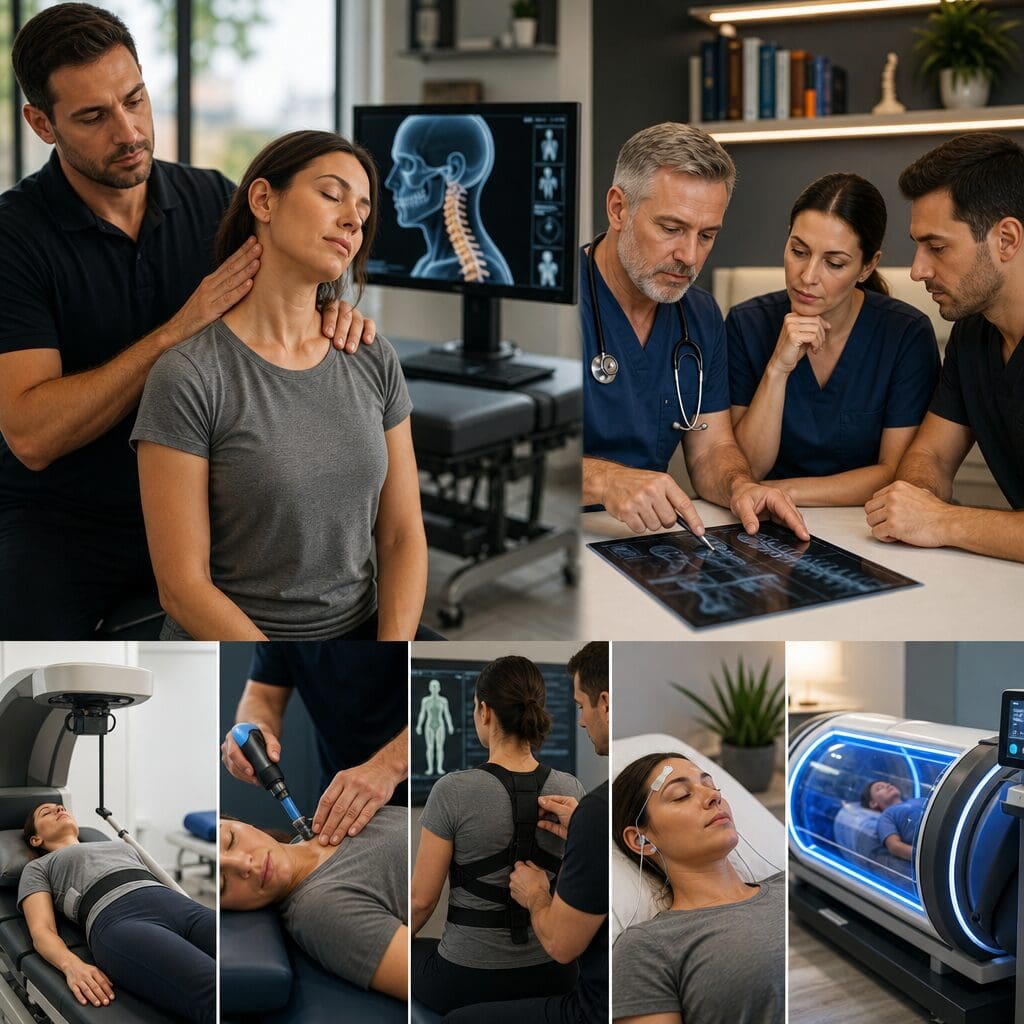
This is what integrative pain management looks like in practice, and it is a primary reason patients are able to taper medications safely under physician supervision.
Takeaway: Look for clinics where providers see your chart together, not just share a waiting room.
Non-Surgical and Non-Drug Therapies We Use to Restore Function
Chronic neck pain treatment works best when it layers several low-risk, high-yield therapies. Our toolkit for non-drug neck pain relief and non-surgical spinal care includes:
- Spinal decompression therapy to reduce disc pressure and create space for irritated nerves.
- Class IV laser therapy to accelerate tissue repair and reduce localized inflammation.
- Manual and instrument-assisted chiropractic adjustments tailored to cervical tolerance.
- Therapeutic exercise and postural retraining to stabilize gains between visits.
- Trigger point and myofascial release for the muscular contributors to nerve compression.
- Nutritional and anti-inflammatory protocols to address systemic factors.
Each therapy is chosen based on what the evaluation reveals, not a one-size protocol. A patient with disc-related pain follows a different sequence than one with primarily facet-driven or muscular pain.
Takeaway: Effective non-surgical care should evolve every few weeks based on your response. If your plan looks identical at visit 12 as it did at visit 2, ask why.
Supporting Recovery With Neurofeedback, Biofeedback, and Regenerative Care
Persistent neck pain physically changes the nervous system. Pain pathways become more sensitive, sleep architecture suffers, and the stress response stays partially activated. Treating only the tissue while ignoring the nervous system is why many patients improve briefly and then relapse.
Advanced neurofeedback therapy trains the brain to regulate itself more effectively, calming the heightened state that fuels chronic pain. Biofeedback teaches measurable control over heart rate variability, breathing patterns, and muscle tension. Patients often describe these sessions as the moment their pain finally started to “let go.”

On the regenerative side, we use therapies designed to support tissue healing rather than mask symptoms. These can include platelet-based injections, peptide therapies, and targeted nutritional support to give discs, ligaments, and nerves the raw materials they need to recover.
Takeaway: If your pain spikes with stress, poor sleep, or weather changes, your nervous system is involved. That is treatable, and it is often the missing piece.
What to Expect During Your Head-to-Toe Evaluation and Treatment Plan
We want you to know exactly what happens when you become a patient. Here is the typical sequence:
- Initial consultation. We review your history, prior imaging, medications, and goals. You will not be rushed through a 10-minute intake.
- Comprehensive head-to-toe evaluation. Physical, neurological, orthopedic, and metabolic assessments are completed under the Vinton Method framework.
- Diagnostic testing as needed. This may include advanced imaging, nerve studies, or lab work to identify inflammatory and metabolic contributors.
- Case review by the team. Our MDs and chiropractors discuss your case together before recommending a plan.
- Personalized treatment plan. You receive a written plan outlining therapies, expected timelines, milestones, and a medication-reduction strategy coordinated with your prescribing providers.
- Progress reassessments. We measure function, pain, range of motion, and quality-of-life markers at set intervals and adjust accordingly.
Most patients begin noticing meaningful changes within the first few weeks, with continued gains as nervous system regulation and tissue healing catch up to the mechanical improvements.
Takeaway: Come to your first visit with a written list of your three most disrupted daily activities. We will use those as recovery benchmarks.
Take the Next Step Toward a Medication-Free Life
Reducing opioid dependence and stepping away from daily pain medications is realistic when the underlying drivers of pain are actually addressed. That requires a team, a method, and a plan built around your specific case rather than a generic protocol.
If you are ready to explore multidisciplinary neck pain management that treats the whole person, we invite you to schedule a consultation at the Pain Relief and Wellness Strategies Center. Bring your imaging, your medication list, and your questions. We will bring the coordinated expertise needed to map a path forward.
A medication-free life is not a slogan. It is the outcome of doing the diagnostic and therapeutic work that fragmented care has not yet done for you. Let us help you take that next step in 2026.